|
||

|
||
|
Streeting Admits Cutting Mental Health NHS Spending In Favour Of US Tech Investment
|
||
|
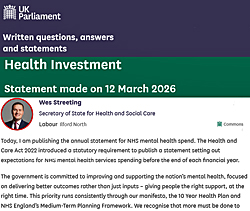
In his written statement to Parliament on 12th March 2026, Wes Streeting Secretary of State for Health and Social Care, made it clear that NHS spending on Mental Health is being cut in order to pay for the investment in Life Sciences digital services in the NHS, which currently is mostly coming from American tech companies!
This continues the aim of aligning UK NHS services and practices with those of the US Healthcare System, according to many NHS Support Groups.
"Today, I am publishing the annual statement for NHS mental health spend. The Health and Care Act 2022 introduced a statutory requirement to publish a statement setting out expectations for NHS mental health services spending before the end of each financial year."
The crucial paragraph, making it clear that cuts are inevitable because of the funding choices being made:
"The proportion of overall NHS spend allocated to mental health in 2026-27 is forecast to be 8.4%, 0.28 percentage points lower than in 2025-26.
This is a consequence of significant additional investment in other core areas, including those that benefit mental health services such as the substantial amounts going into NHS technology and digital transformation, general practice, community-based services, and Neighbourhood Health Centres.
These system-wide improvements are focused on fixing the fundamentals of the NHS and, although they are not counted in pure mental health service spend, will deliver significant benefits for mental health services and patients. There are also important areas of mental health related expenditure not captured in the share of spend figure, such as prescribing mental health medication, continuing healthcare and NHS England’s investment in training the mental health workforce."
Rebecca Gray, NHS Confederation and NHS Providers’ mental health director, said having effective mental health services is “central” to well-performing neighbourhood-based healthcare; reports the HSJ.
She warned:
“Providers of NHS mental health care across the country are working hard to drive up the value of every pound spent - focussing on improving outcomes, increasing productivity and maximising the use of new technologies. Having effective mental health services is central to ensuring well-performing neighbourhood-based healthcare to deliver against the government’s ambition for a shift towards community-based, preventive, and early intervention support.”
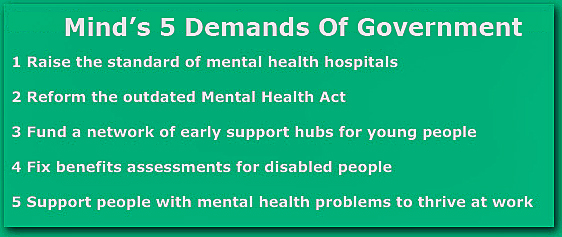
Meanwhile, Mind charity warned mental health makes up 20 per cent of illness the NHS has to treat, despite now receiving less than 9 per cent of funding.
It referred to data published today showing a record of over 2.2m people were in contact with mental health services in January 2026, surpassing 2.19 million in December 2025.
CEO Sarah Hughes added: “The UK government is currently carrying out reviews into the prevalence of mental health problems and the delivery of mental health services. But the findings, recommendations and policies implemented off the back of these reviews will be undermined if mental health care is increasingly under-resourced and government shows no urgency in prioritising mental health.”
On the back if this reduction in funding for NHS patient mental heralth support services and treatment, both Palantir and Epic from the US are furthering their deepening tech into the NHS and in systems that will form the new structures of the NHS:
The much heralded and controversial from spy-tech company Palantir - the Federated Data Platform System and a Patient Record System from American Company Epic which already has a major stake in the NHS patient delivery systems.
Though headquartered in Wisconsin, US, Epic's presence is expanding internationally, including significant adoption within the NHS with Major Trusts of King’s College Hospital and Guy’s and St Thomas’ already using their patient record system. A recent £222m contract will bring Epic to four trusts across Dorset and Somerset by 2028.
To access Epic-based hospital records, patients will have to use two main digital methods:
The current situation of differing Hospital system not being able to 'talk' with one another is likely to continure within a fractured NHS with each individual Hopsital NHS Trust doing their own thing along with their ICBs. Opponents can only see a total mess with half American based systems owning tech data, and systemts not matching each other or being compatable, as is the case in the US system.
This will lead to the 'Americanisation of the NHS and evetually to a private health insurance system being in place of the NHS, although as is now, them remaining badged to the NHS without patients actually knwoing who their healthcare is being provided by.
Source: HSJ / Gov.UK
|
||
| MHN News Page |

|
Unionsafety Main Page |
|
Designed: Chris Ingram, Jamie McGovern |
||